
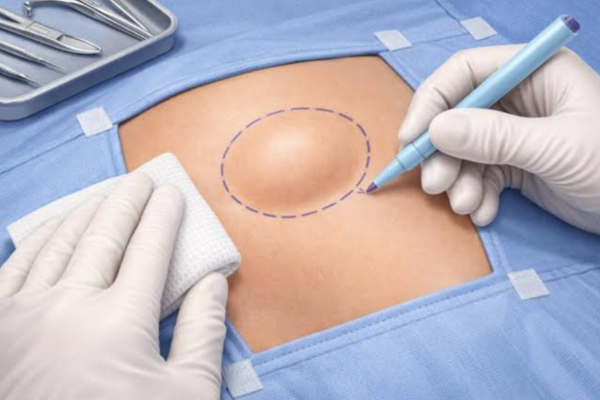
Safe and Effective Treatment for Lipomas with Expert Surgical Care
About Lipoma
Lipomas commonly occur on:
- Neck
- Shoulders
- Back
- Arms
- Chest
- Abdomen
- Thighs
Although most lipomas do not require treatment, surgical removal may be recommended if they become large, painful, or cosmetically bothersome.
Symptoms of Lipoma
Common signs and symptoms include:
- Soft lump beneath the skin
- Slow-growing swelling
- Movable mass under the skin
- Painless fatty lump
- Mild tenderness in some cases
- Cosmetic concerns
- Pressure on nearby tissues or nerves
- Restricted movement if located near joints
If a lump changes rapidly in size or becomes painful, medical evaluation is recommended.
Causes of Lipoma
• Genetic Factors – A family history of lipomas may increase the likelihood of developing these benign fatty growths.
• Age – Lipomas are most commonly found in adults between 40 and 60 years of age, although they can occur at any age.
• Minor Injury – In some cases, lipomas may appear after trauma or minor injury, though the exact relationship is not fully understood.
• Certain Medical Conditions – Rare hereditary and genetic conditions may contribute to the development of multiple lipomas throughout the body.
Diagnosis of Lipoma
Our specialists perform a comprehensive evaluation to confirm the diagnosis.
Clinical Examination
- Assessment of lump size
- Evaluation of mobility and consistency
- Review of symptoms
Imaging Studies
- Ultrasound
- MRI or CT scan when necessary
- Imaging for deeper or larger masses
Tissue Analysis
In selected cases, further testing may be recommended to rule out other conditions.
Accurate diagnosis ensures appropriate treatment planning and peace of mind.
Lipoma Treatment Options
Observation
Small, painless lipomas that do not cause symptoms may simply be monitored over time.
Surgical Lipoma Removal
The most effective treatment for symptomatic or enlarging lipomas.
Procedure Includes:
- Local or general anesthesia depending on size and location
- Small incision over the lipoma
- Complete removal of fatty tissue
- Careful wound closure
Surgical excision usually provides permanent removal with a low chance of recurrence.
Minimally Invasive Lipoma Removal
Selected patients may benefit from smaller-incision techniques designed to reduce scarring and recovery time.
Benefits of Lipoma Removal Surgery
- Complete removal of the lipoma
- Relief from discomfort or pressure
- Improved appearance
- Prevention of further enlargement
- Better mobility when near joints
- Accurate diagnosis through tissue examination
- Low recurrence rate
- Minimal scarring with advanced techniques
- Quick recovery in most cases
Why Choose Nirvi 2 Surgical and Maternity Hospital?
• Experienced Surgeons – Skilled specialists experienced in soft tissue surgery and minor surgical procedures, including lipoma removal.
• Accurate Diagnosis – Comprehensive evaluation and assessment to ensure proper diagnosis and effective treatment planning.
• Advanced Surgical Techniques – Modern methods focused on safety, precision, and optimal cosmetic outcomes.
• Personalized Treatment Plans – Customized care based on the size, location, symptoms, and individual patient needs.
• State-of-the-Art Facilities – Modern operation theaters equipped with advanced technology and patient monitoring systems.
• Minimal Scarring Approach – Surgical techniques designed to minimize scarring and achieve excellent cosmetic results.
• Comprehensive Postoperative Care – Dedicated follow-up support and guidance to promote smooth healing and recovery.
Our Lipoma Removal Process
Step 1: Consultation & Evaluation
Assessment of the lump, symptoms, and medical history.
Step 2: Diagnostic Investigation
Ultrasound or additional imaging if required.
Step 3: Treatment Planning
Selection of the most suitable removal technique.
Step 4: Lipoma Removal Procedure
Safe surgical excision performed under appropriate anesthesia.
Step 5: Recovery & Observation
Monitoring and postoperative care instructions.
Step 6: Follow-Up Visit
Evaluation of wound healing and recovery progress.
Step 7: Long-Term Monitoring
Guidance on maintaining skin health and monitoring for any future concerns.